
Text and images by Zoë Poulsen
New Year’s Eve 2019: In the small Overstrand town of Betty’s Bay a boat flare was set off, landing in the fynbos on the mountains above. The stage was set for what was to be one of the biggest blazes of this year’s fire season. Each year across South Africa’s Fynbos Biome as temperatures rise and summer comes, the veld becomes a tinder box, prone to ignition from rockfalls, lightning strikes, that carelessly thrown cigarette stompie, or a boat flare let off in a reckless moment of thoughtlessness. In summer the beautiful, highly biodiverse, fire prone and fire dependent fynbos can be a tough neighbour to live alongside when wildfire comes knocking at the door.

Above: The lower section of Harold Porter NBG three weeks after the Betty’s Bay fire.
Fuelled by strong winds, the fire moved quickly down the mountain flanks in the early hours of the morning, leaping across the R44 and threatening the nearby settlements of Betty’s Bay, Pringle Bay and Hangklip. Terrified residents were evacuated as fire teams fought the blaze through the night. Tragically one life was lost and two other people were seriously injured. As windspeeds rose to gale force, for days the blaze raged through thousands of hectares of the Kogelberg above with numerous fire teams across municipalities working around the clock on multiple fire lines.

Above: Leopard’s Kloof at Harold Porter NBG three weeks after the Betty’s Bay fire.
On Friday 11thJanuary, further fuelled by gale force winds, to the horror of residents and all others watching, when it was thought to be almost under control in the area, the wildfire flared up again, barrelled down from the mountains into Harold Porter NBG and onwards into the heart of the town. Fire teams fought in desperation to save lives and property, but 41 houses were destroyed and 28 were badly damaged. Many people lost everything and the community was left reeling by what was one of the worst wildfires affecting the Overstrand in more than 30 years.
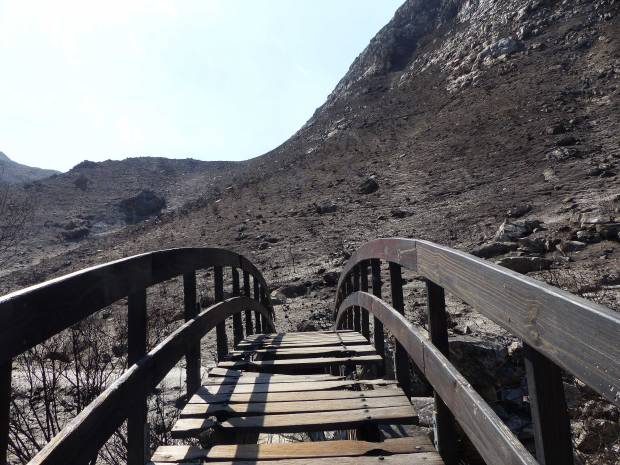
Above: The bridge at the bottom of Leopards Kloof after the Betty’s Bay fire.
Harold Porter National Botanical Gardens sits at the heart of Betty’s Bay, where the Kogelberg meets the town. The gardens are integrated within the surrounding fynbos landscape and the forested Leopard Kloof and Disa Kloof. Although many parts of the garden and its infrastructure were lucky enough to emerge relatively unscathed, a considerable area burnt in the fire and the fynbos surrounding the garden looked like a lunar landscape when visiting just after the fire.

Above: Burnt seedheads open to shed their seeds hours after the fire.
Blackened stems of fynbos shrubs stuck at awkward angles above ash covered ground, starting at zero waiting for life to return again. The landscape appears desolate and devoid of all life. Occasionally seen in the veld are the sad remains of a tortoise or snake who stood no chance. Nature can be cruel.
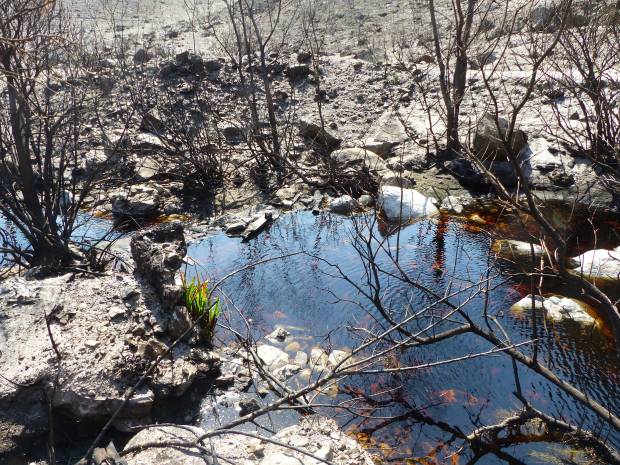
Above: Stream below the Zigzag Trail in Harold Porter NBG three weeks after the Betty’s Bay fire.
And yet without fire there would be no fynbos. No matter the cause fynbos will always burn. Fire is an integral part of the ecology of fynbos vegetation. Many plants within the fynbos are completely dependent on fire to regenerate, flower or grow anew from seed. While walking through this blackened landscape just three weeks after the fire, frogs could be heard calling from the brown tannin coloured streams running through the fynbos, seeming an incongruous sign of life going on despite the devastation.
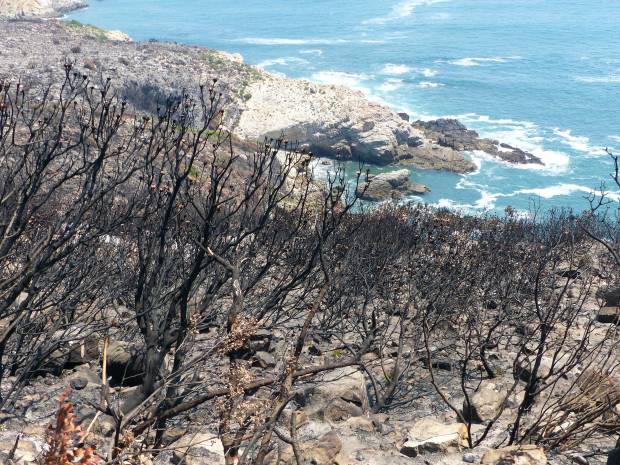
Above: Fynbos below the R44 burnt in the Betty’s Bay fire. Seedheads have opened already to disperse seed, triggered by the fire burning through the veld.
Within hours of the fire the cones of members of the Proteaceae family open, spilling their seeds onto the ground, leaving a cornucopia of food for those rodents that have survived. Fynbos wildlife has adapted in many ways to survive when fire moves through the landscape. Insects and birds will fly from the fire and many insects and spiders will survive as eggs or pupae buried in the soil or underground in ants nests. Many reptiles are adapted to take refuge in rock cracks or rodent burrows. Tortoises often survive veld fires in this way but often there are some that aren’t so lucky. Larger mammals often run from the flames. Numbers of some rodents such as the Pygmy Mouse will actually increase after a fire owing to their preference and tolerance of more open landscapes.
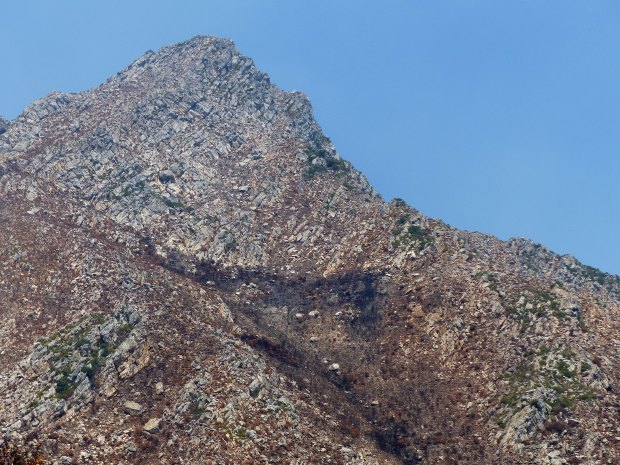
Above: Mountain slopes above the R44 burnt in the Betty’s Bay fire. Note the areas of green between rocks acting as fire refugia for fire sensitive flora and relatively safe havens for escaping wildlife.
In the upper reaches of the botanical gardens above the sweeping lawns and formal flowerbeds, across the ash covered landscape the first few green shoots of re-sprouting plant species are starting to emerge already. Two weeks after the fire splashes of red can be seen against the grey ash on the upper slopes by the more observant of garden visitors. These are colonies of Fire Lilies (Cyrtanthus ventricosus), their profuse flowering triggered by the heat of the fire. Flower buds can emerge as soon as two weeks after a burn, followed by leaves that grow throughout the winter before dying back in late spring. They will not be seen flowering here again until after the next fire.
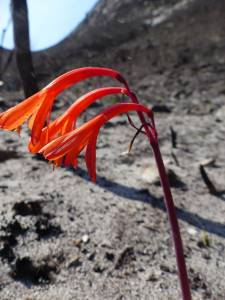
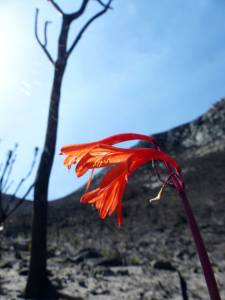
Top & Above: Fire Lilies (Cyrtanthus ventricosus) flowering at Harold Porter NBG in the first two weeks after the Betty’s Bay fire.
As the weeks and months go by, further triggered by autumn and winter rain and cooler temperatures, seeds will germinate and grow, their dormancy having been broken by the heat from the fire. Many plants such as Orchids and many annual species will take advantage of the removal of the shade from the shrubby overstorey to grow and flower. Bulb species commonly flower en masse soon after a burn. When spring comes around the veld will be blooming in a profusion of colour. This is a time to observe and learn about this extraordinary growth and change in the fynbos of Harold Porter NBG and the surrounding area.

Above: New shoots of fynbos post fire resprouters starting to emerge after the Betty’s Bay fire.
There are no words for the human losses from this wildfire. My heart goes out to all those affected. And yet after this tragedy there will come new life in the veld. It may not seem so now amidst the chaos, pain, loss and destruction, but out of the ashes of this fire will come new life, like a phoenix. Time to watch and wait…..
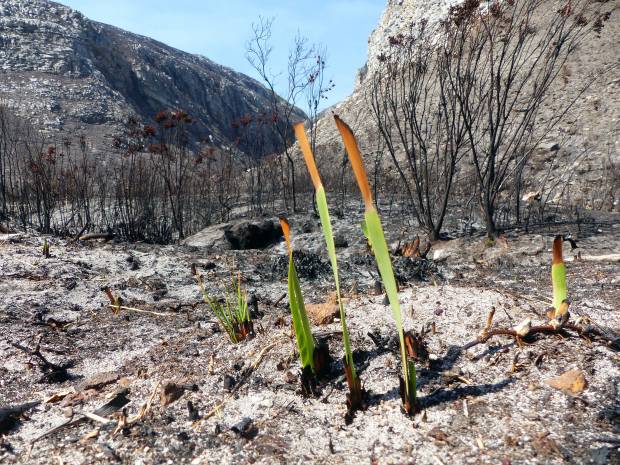
Above: The first new shoots of geophytes (bulbs) emerging at Harold Porter NBG after the Betty’s Bay fire.
Recent Comments