
Fire, aliens and the future of fynbos
Inadequate fire planning and persistent invasive species continue to be major threats to indigenous biodiversity – doubly so when conservation efforts are done in isolation. MARTINA TREURNICHT, KIRSTEN WATSON and ANDREW TURNER revisit the challenges and potential solutions discussed at last year’s Fynbos Forum.
PHOTOS BY MARTINA TREURNICHT AND FYNBOS FORUM 2025
During the Fynbos Forum workshop, Andrew Turner unpacks practical approaches to using prescribed burns strategically to support more effective and affordable follow-up clearing of invasive alien plants
“How can we, as a conservation collective, better manage fire and invasive alien plants across the Cape Floristic Region (CFR)?”
This question was addressed by conservation practitioners, researchers, land managers and NGOs gathering at a workshop of the annual Fynbos Forum conference in August 2025, hosted at the Wilderness Hotel.
The workshop focused on an urgent reality: Threats of inappropriate fire regimes to biodiversity and the spread of invasive alien plants are growing, and are often interconnected. Managing these threats separately is generally not effective.
The discussion highlighted the need for integrated fire and invasive plant management – across entire catchments and landscapes, and not in isolated projects. It calls for a shift from reactive responses to proactive stewardship, where landowners, communities and institutions work together to balance ecological, social and economic priorities.
When fire and invasives collide
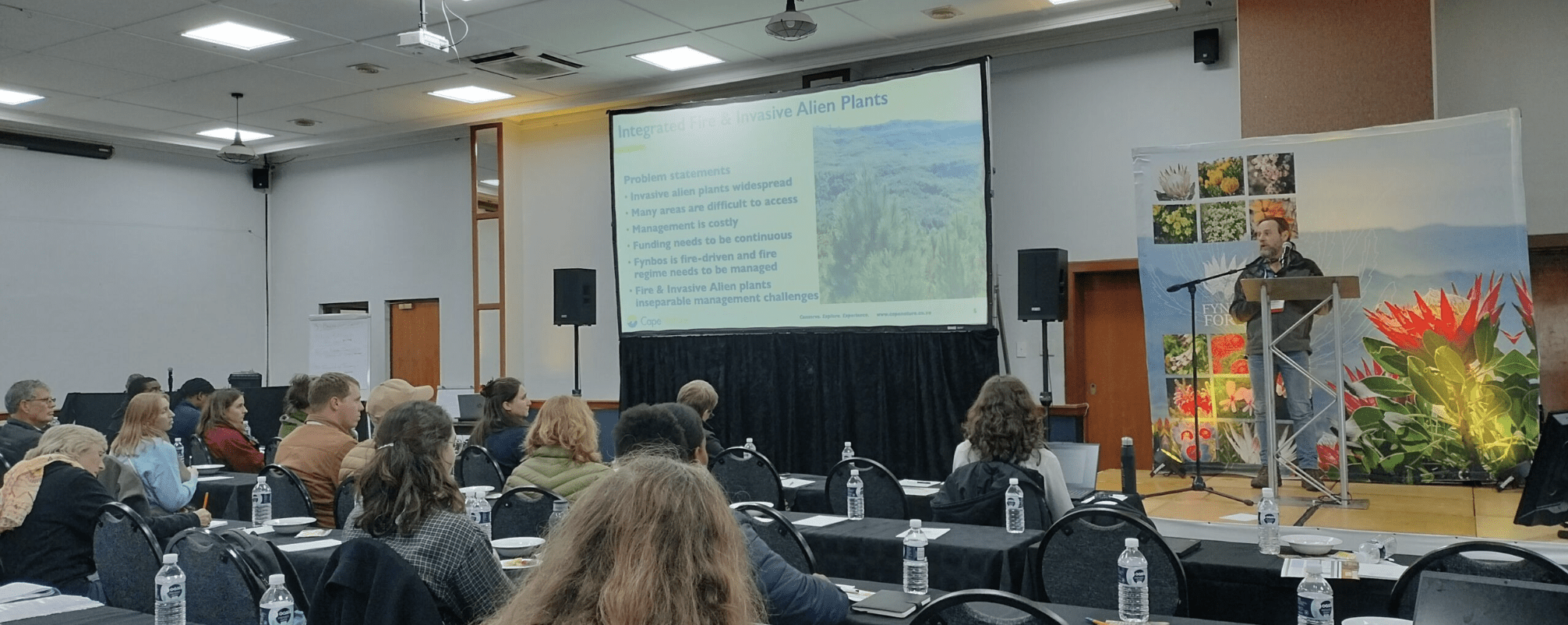
During the Fynbos Forum workshop, Andrew Turner unpacks practical approaches to using prescribed burns strategically to support more effective and affordable follow-up clearing of invasive alien plants
The CFR is one of the world’s most remarkable biodiversity hotspots and home to many endemic plant species. Yet this globally important region faces mounting pressure from invasive alien plants (IAPs) such as pines, wattles and gums.
IAPs pose a significant threat to biodiversity, particularly in fire-prone ecosystems like the fynbos biome. Fynbos ecosystems evolved with fire, and fynbos plants are adapted to periodic burns that stimulate seed germination, reset ecological processes and help maintain species diversity.
However, the situation changes dramatically when IAPs start to dominate the landscape. Invasive trees often produce far greater biomass than indigenous fynbos, creating dense stands that burn at higher temperatures and more intensely. After fires, many invasive species also regenerate aggressively and far quicker than our fynbos plants, which are often outcompeted.
This creates a vicious cycle: Alien plants increase fire risk, fires stimulate further invasions (often at higher densities) and repeat – with affected ecosystems progressively degrading over time.
However, fire can also be part of the solution – which was a major point of discussion at the Fynbos Forum 2025 workshop. When used strategically, prescribed burns can reduce dense stands of invasive alien plants and make follow-up clearing more effective and affordable. But this can only work if burning is integrated with careful planning and regular follow-up clearing operations. Currently, fire management and invasive plant clearing are often planned separately, resulting in missed opportunities for ecological restoration.
The race we are losing
One of the most sobering discussions during the workshop centred on the mismatch between the speed of invasion and the speed of clearing.
Invasive alien plants spread rapidly across the landscape, often reaching reproductive maturity within just a few years. Pines, for example, can begin producing seeds within six years. By contrast, clearing operations are often slow, labour-intensive and costly. The manual clearing of dense infestations may require on average 25 to 100 person-days per hectare, especially in rugged or remote mountainous terrain.
Even when areas are successfully cleared, delays in follow-up clearing work often allow invasive plants to reinvade recently burnt areas even faster. Funding interruptions, administrative delays and limited contractor capacity may further slow progress. The result is often that valuable resources are invested in clearing, but without consistent follow-up the potential gains are quickly lost.
Fire planning can help address this mismatch. Strategic burns can reduce dense biomass quickly and make landscapes more accessible for follow-up clearing teams. But this approach carries risk if timely post-fire clearing is not guaranteed, highlighting the need for long-term planning rather than short-term project cycles.
Thinking in decades, not years
Effective restoration of invaded fynbos landscapes requires patience, persistence and consistent effort in clearing. Some programmes are now adopting planning horizons of 20 to 30 years, supported by detailed annual operational plans.
This approach recognises that clearing IAPs is not a once-off intervention, but a long-term commitment that involves initial clearing, repeated follow-up operations, ongoing monitoring and a consistent investment of resources.
Technological tools have also become very helpful. Remote sensing, satellite imagery and vegetation mapping can help identify invasion hotspots, assess burn severity and prioritise initial clearing and follow-up work more efficiently. These tools can provide valuable data and improve planning, but they cannot replace one critical ingredient: sustained funding.
Funding restoration in new ways
A recurring topic throughout the workshop was the need for innovative financing models to support large-scale IAP control and clearing. Conservation funding is often short-term and project-based, which is not sufficient to address the scale of the problem.
One potential solution discussed by participants is to link restoration work to water security. Invasive trees consume large amounts of water, reducing streamflow and dam levels. Clearing these plants can therefore increase water availability. Water utilities and municipalities could potentially contribute to restoration funding through water tariffs or catchment protection levies.
Another idea involves working with the insurance industry. Healthy ecosystems reduce wildfire risk and protect infrastructure, and insurers are beginning to recognise the value of investing in ecological restoration as a form of risk reduction. Resilience bonds – financial instruments that fund projects reducing disaster risk – were also discussed as a potential mechanism.
Participants also highlighted opportunities to make better use of biomass from cleared alien plants. Timber, charcoal, biochar and other products that could create local economic opportunities while offsetting clearing costs.
The bigger picture
Perhaps the most important message from the workshop was that IAP control cannot succeed in isolated patches. Fynbos landscapes are connected systems: seeds disperse across property boundaries, fires move across mountains and valleys and rivers link upstream and downstream ecosystems.
If one landowner invests heavily in clearing but neighbouring properties remain invaded, reinvasion is almost inevitable, so the importance of catchment-scale collaboration is vital. Landowners, conservation organisations, municipalities, fire protection associations and government agencies all need to work together.
One practical example highlighted during the workshop was the Greater Cape Town Water Fund, which coordinates restoration work across key water catchments supplying the city. Such collaborative models allow partners to share data, align priorities and pool resources. They also make it easier to plan integrated fire management, coordinate prescribed burns and ensure consistent follow-up clearing.
A way forward
Encouragingly, several initiatives are already underway to strengthen integrated threat management in the CFR. A dedicated integrated fire and invasive alien plant working group has been established through the Cape Floristic Region Partnership. This group brings together technical experts, municipalities and fire protection associations to support better coordination and strategic planning. It also aims to promote practical solutions that align ecological restoration with wildfire risk reduction, which happens by developing guidelines, improving planning tools and sharing lessons from successful projects.
Many of the most effective restoration efforts happen when people who live and work in the landscape become active stewards of the land. So, empowering landowners and local communities is also essential. Training, knowledge-sharing and accessible resources can help build a strong environmental stewardship culture.
For plant lovers, hikers, volunteers and landowners across the CFR, the message is clear: protecting fynbos requires more than admiration for its beauty. It requires collective action, sustained commitment and a willingness to rethink how we manage our landscapes.
About the authors
Martina Treurnicht is the conservation project manager of BOT SOC SA and the chairperson of Fynbos Forum.
Kirsten Watson is the manager of the Greater Cape Town Water Fund at The Nature Conservancy.
Andrew Turner is a biodiversity conservation scientist working as a scientific manager at CapeNature.


JOIN BOTSOC
JOIN NOW

Hours
Tuesdays from 08h00 to 16h00. Closed from Wednesday to Monday and public holidays.
Contact Us
We are experiencing intermittent faults with our landlines. If you can't get through on our landline +27 (0) 21 797 2090 , please phone or send a message to our alternate WhatsApp number: +27 (0) 65 922 6163.
Notice
From 1 March 2026, our office located inside Kirstenbosch National Botanical Garden (through Gate 2) will be open to assist members on Tuesdays only (08:00 – 16:00).
0 Comments