CONSERVATIon
An introduction to the Little Karoo
NOV 13, 2020 | Written by Zoë Chapman Poulsen. Photos by @bionerds.co.za.
Little Karoo
Above: Crassula rupestris on a shale bank in the central Klein Karoo. Photo: @Bionerds.co.za.
What is the Little Karoo?
Also known as the Klein Karoo, South Africa’s Little Karoo region is a semiarid intermontane basin that is located between the Langeberg, Outeniqua and Tsitsikamma mountains to the south and the Swartberg mountains to the north.
Despite relatively low average annual rainfall, attributed to the rain shadow created by the surrounding mountain ranges, the Little Karoo is one of South Africa’s prime agricultural areas with extensive areas of vineyards, stone fruits, sheep, cattle and ostrich farms.
The region is also known for the R62 road and tourist route, a popular journey between the Garden Route and Cape Town.
Perhaps less well-known is that this beautiful region forms part of South Africa’s Succulent Karoo Biome, which is identified as one of the country’s three biodiversity hotspots. South Africa’s Succulent Karoo is home to the richest diversity of succulent plant species on earth.

Above: Fat and happy Babies Bottom in the arid Klein Karoo. Photo: @Bionerds.co.za.
Vegetation of the Little Karoo
One key factor that makes the Little Karoo’s biodiversity so special is that there are a variety of different vegetation types that intersect across the region, ranging from uplands to lowlands. Key environmental factors that act as determinants of distribution of different vegetation types include local geology, average annual rainfall, temperature and fire regimes. All contribute to the presence of a multitude of different microhabitats, such as the quartz patches pictured above.
In the mountains that surround the region, fynbos vegetation can be found at higher altitudes that receive higher rainfall. The vegetation found within the various fynbos habitats vary in composition including whether they are dominated by members of the Ericaceae or Proteaceae family or degree of grassiness of the vegetation.
Arid or moist renosterveld is found in areas on heavier soils, dominated by shrubs from the Asteraceae family. Succulent Karoo vegetation is found predominantly on the lowlands. The area is also home to various different types of Sub-Tropical Thicket, often dominated by spekboom (Portulacaria afra).

Above: Gibbaeum heathii in flower. Photo: @Bionerds.co.za.
Regional Biodiversity
The Little Karoo is known for its extraordinary plant species richness. More than 3 200 plant species occur across the region, of which more than 400 species are endemic to the area and are known from nowhere else on earth.
The Little Karoo contains vegetation from three different biodiversity hotspots, namely the Fynbos Biome, Succulent Karoo Biome and subtropical thicket from the Maputaland-Albany-Pondoland Biodiversity hotspot.

Above: Gibbaeum pubescens, Sanbona Wildlife Reserve, Klein Karoo. Photo: @Bionerds.co.za.
Ecosystem Services
The Little Karoo has relatively complex hydrology that feeds into the area’s use for agriculture. Fynbos mountain catchments with many seepages act as ‘living sponges’ in areas where rainfall is higher, feeding into freshwater streams that feed into larger watercourses and groundwater which are in turn sources of irrigation water.
Much of the veld across the region is used for grazing livestock, including sheep, cattle and ostriches. However, the veld is in danger of not being able to provide this ecosystem service if overutilised.
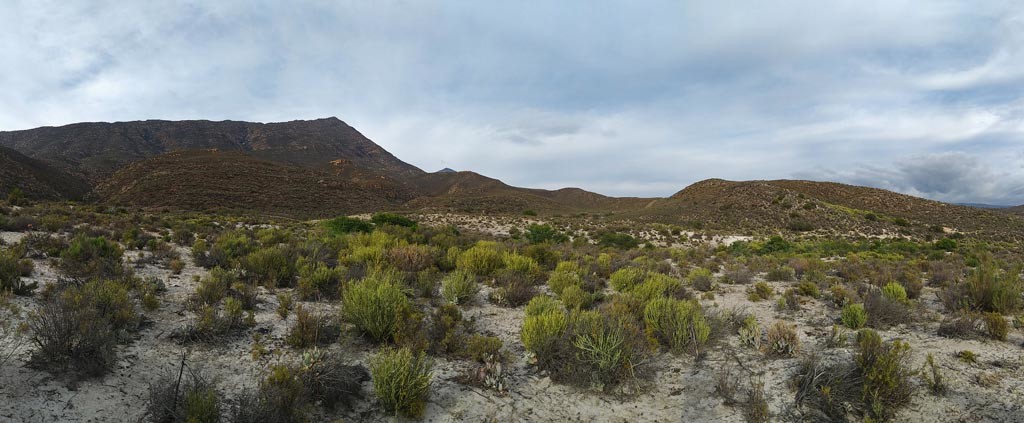
Above: Iconic quartz patches in the Barrydale District, Klein Karoo. Photo: @Bionerds.co.za.
Conservation Challenges
Sadly many of the most iconic succulent species that call the Little Karoo home are threatened by illegal collection from the wild for the horticultural trade. Around 50% of the region’s vegetation is under severe grazing pressure from domestic livestock including ostriches.
Much of the area’s veld also naturally has extensive biological soil crusts including mosses and lichens that rapidly break down as a result of livestock trampling. A further 10% has been converted to cultivation, with around 49% of the area’s natural vegetation surviving, leading to declines in ecosystem services, flooding and soil erosion.
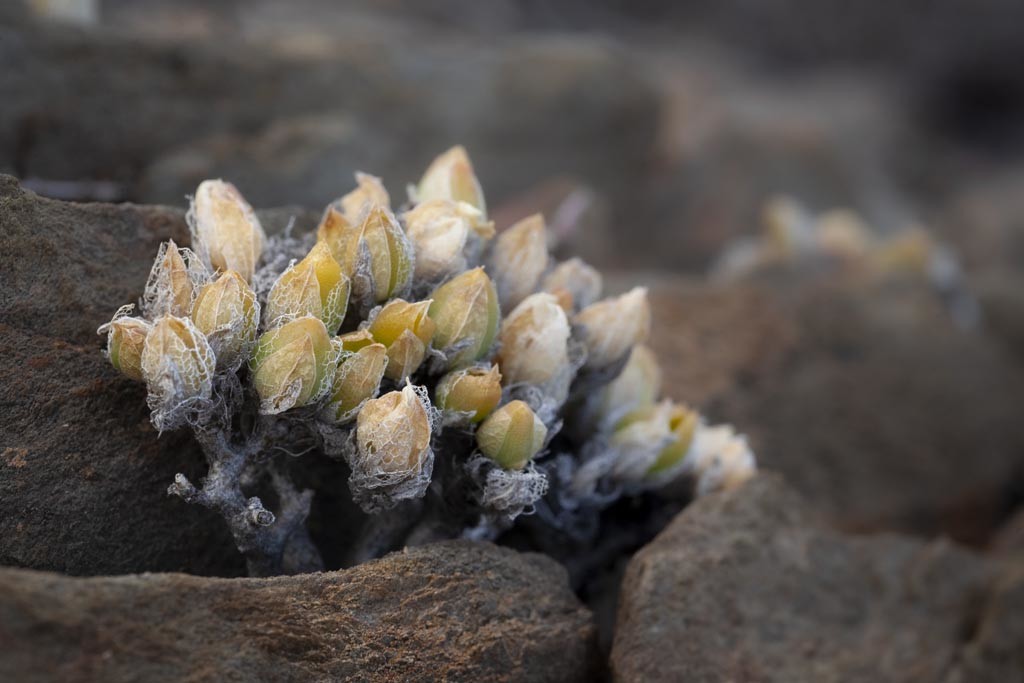
Above: Sceletium tortuosum in situ. Warmwaterberg. Photo: @Bionerds.co.za.
Conserving the Little Karoo’s Biodiversity
Various different conservation partners have come together to help conserve nature in the Little Karoo but there is still much work to be done.
With the support of the Leslie Hill Succulent Karoo Trust and other associated trusts and donors, WWF South Africa has played a key role in conservation through land purchase in the region, purchasing almost 70 000 ha to support the conservation of rare and threatened species and their associated habitat, ensuring connectivity across the landscape. This comprises 51 000 ha to expand Anysberg Nature Reserve, 14 000 ha adjacent to Gamkaberg Nature Reserve including key expansion properties for mountain zebra populations and 4 000 ha to expand Swartberg Nature Reserve. These reserves are managed by CapeNature.

Above: The botanical diversity in the quartz rich Klein Karoo. Photo: @Bionerds.co.za.
Landscape level coordination in the region was formalised in 2003 with the start of the Gouritz Initiative, which eventually led to the establishment of the UNESCO designated Gouritz Cluster Biosphere Reserve in 2015. A key component of this work is the Gouritz Initiative Forum, which is a platform and regular meeting space for a diverse range of stakeholders united by the common goal of a sustainable future for the Little Karoo; with one of its key aims being to address the disconnection between people and nature.
As the conservation work of the Botanical Society gains momentum, we will be actively involved in working alongside partners to appreciate and conserve the floral biodiversity of the Little Karoo for future generations.
We would like to thank our partners at WWF South Africa for contributing information to this article on their protected area expansion work in the Little Karoo.

Above: Tritonia segurigeri subsp. watermeyeri, a range restricted endemic from the Klein Karoo. Photo: @Bionerds.co.za.
Further reading
Egoh, B.N. Reyers, B. Carwadine, J. Bode, M. O’ Farrell, P. Wilson, K.A. Possingham, H.P. Rouget, M. De Lange, W. Richardson, D.M. Cowling, R.M. (2010) ‘Safeguarding biodiversity and ecosystem services in the Little Karoo, South Africa’, Conservation Biology (Volume 24): pp. 1021-1030.
Vlok, J. Schutte-Vlok, A. (2010) Plants of the Klein Karoo, Umdaus Press, Hatfield, South Africa.
5 Comments
Submit a Comment


JOIN BOTSOC
Know, grow, protect and enjoy South Africa’s indigenous plants.
JOIN NOW


Hours
Tuesdays from 08h00 to 16h00. Closed from Wednesday to Monday and public holidays.
Contact Us
We are experiencing intermittent faults with our landlines. If you can't get through on our landline +27 (0) 21 797 2090 , please phone or send a message to our alternate WhatsApp number: +27 (0) 65 922 6163.
Notice
From 1 March 2026, our office located inside Kirstenbosch National Botanical Garden (through Gate 2) will be open to assist members on Tuesdays only (08:00 – 16:00).
THANK YOU SO MUCH for this beautiful article on the Little Karroo – you have made my Christmas – such a good time to promote all this beauty at this sad time of this dreadful
virus. Hope it brings much joy to everyone who reads it.
A VERY HAPPY CHRISTMAS and a PROSPEROUS NEW YEAR to all at Botsoc !
I have just loved this interesting and factual offering. Please continue in this vein.
Interesting article
Very good to read/know. As a land owner in the Klein karoo, and advocates of permaculture, how can we help this cause?
Hi,
We stay on Hillside Guest Farm Self Catering Chalets in the Klein Karoo on the Jonckrus/de Vlugt road, and the vegetation here is indescribable beautiful. I love walking here, always something new to see, sooo much for me to learn still, but its breathtakingly beautiful. The fine flowers are a sight to behold, especially in spring. We are so blessed to be able to stay here.