

The Portulaca cold case: Uncovering a nearly lost succulent after 90 years
In what felt like the plant world’s own cold case, a team of researchers set out to track down a Portulaca species that hadn’t been seen in nearly 90 years. From combing through herbaria and poring over scientific articles to venturing out into the saltpans in search of this elusive plant, these determined researchers never gave up. WYNSTON WOODENBERG, YANADAYALAN GOVENDER & SYD RAMDHANI share the story of their journey.
PHOTOS BY WYNSTON WOODENBERG, SYD RAMDHANI & RANGANI NEMANDO
Portulaca grandiflora with its showy magenta flower – one of the largest flowers among the Portulaca species. Photo: Wynston Woodenberg
You never quite expect to rediscover a plant species that’s been ‘lost’ for nearly 90 years, but that’s exactly what happened to us during a recent research project. Portulaca is a small genus of succulent plants often identified by their hairy leaf axils and their fruit capsules that crack open to release many tiny black seeds. With over 100 species scattered across the globe, Portulaca species thrive in tropical and subtropical areas, particularly in Africa and South America.
One of the most common Portulaca species, purslane (Portulaca oleracea), is a weed most of us have walked over more than we realise. You’ll spot it growing in the cracks of pavements, along roadsides and disturbed areas. Recently, this modest plant has been celebrated as a true “superfood”, packed with antioxidants and omega-3 fatty acids. This is a rarity in the plant world, where we typically rely on fish for those essential fats. Gardeners also love other Portulaca species, such as moss rose (P. grandiflora) and wingpod purslane (P. umbraticola), both known for their showy flowers that come in a variety of colours.
A 163-year knowledge gap
My own relationship with Portulaca blossomed four years ago when I joined the South African National Biodiversity Institute (SANBI) as a plant taxonomist. My mission? To do a taxonomic revision of the Portulaca species in southern Africa. The last thorough study on these little succulents in the region was published in 1862 – an astonishing 163 years ago. Back then, the record for southern Africa listed just three species: purslane, chicken weed (P. quadrifida) and the interestingly named “kiss-me-quick” (P. pilosa).
Fast forward to the present day, SANBI’s NewPOSA (Plants of Southern Africa) website hinted at about 10 species in the region, one of which had not been seen or documented since 1934: Portulaca trianthemoides. It was like the plant world’s own version of a cold case, and we were determined to crack it.
The species was first discovered in 1931 by two botanists, Cornelis Bremekamp and Herold Schweickerdt, in the ‘Zoutpansberg’ (Soutpansberg) area of Limpopo. Two specimens of the plant were collected and deposited in the National Herbarium in Pretoria (PRE) – a facility that stores a collection of dried, preserved plant specimens and their associated information including the plant description, locality, habitat, altitude, collector name/s, collection date, etc.
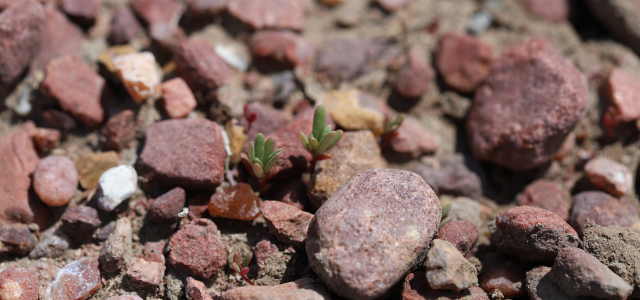
A few young seedlings growing between stones on the berm of the saltpan. Photo: Wynston Woodenberg
The start of the search
Portulaca trianthemoides was first described as a new species by Bremekamp in 1933, and a year later Schweickerdt and Inez Verdoorn collected just one more specimen and sent it to Kew’s Herbarium in England.
These three specimens gave us very little clue as to the exact whereabouts of this mysterious plant. However, while searching for additional specimens at the University of Pretoria’s Schweickerdt Herbarium, Magda Nel and Kenneth Oberlander connected us with Norbert Hahn of Herbarium Soutpansbergensis, who then pointed us to another scientific article, written by Anna Obermeyer in 1937. In that article, Obermeyer describes in more detail two of Schweickerdt’s visits to Farm Zoutpan, where P. trianthemoides was recorded as growing “along the margins of the pan”. This was the breakthrough we needed to finally solve the mystery of the missing plant.
With this clue in hand, we used QGIS software and Google Earth to locate the farm. After a long journey from Durban to Limpopo and some light bureaucratic hoop-jumping (including a permit from the Limpopo Economic Development Environment and Tourism department), we finally had the necessary permission in place to search the farm.
Fooled by a look-alike
The landowner turned out to be a very likeable character, full of jokes that had us in stitches before we started our fieldwork. That first afternoon, we combed the area surrounding the saltpan and found a few plants that could have been our mysterious species. However, it turned out to be a Trianthema species, which probably attests to the name trianthemoides, meaning ‘resembling Trianthema’.
Just before sunset, however, I spotted small seedlings with coppery-red leaves that seemed to match the original description of the species, but we couldn’t quite confirm if they were in fact Portulaca as we didn’t see mature plants with flowers and/or fruit. However, we left with hope that we were onto something.

Wynston Woodenberg (left) and Teddy Govender (right) couldn’t hide their excitement at finding the species. Photo: Syd Ramdhani
“I’ve found it!”
The next morning, we decided to divide and conquer. Syd Ramdhani and I picked up where we left off the previous day, while our colleagues Yanadayalan (Teddy) Govender and Mkhipheni Ngwenya headed east. It wasn’t long before my phone rang – Uncle Teddy (as we fondly call him) was on the other end, his voice brimming with excitement. “Come quick, I’ve found it!” he shouted. “Are we sure it’s not oleracea?” I double-checked. “No, this is different!” he replied.
We rushed over, and sure enough, we had found it: Portulaca trianthemoides, growing in open sandy patches amid the savanna grasses.
Once again, Uncle Teddy’s built-in plant-finding radar had come through. We had found the plants. Mission accomplished. And not just one or two of them – there were thousands (an estimate of more than 15 000 plants), their sunshine-yellow flowers beginning to bloom. This was different from the red-flowered, cylindrical-leaved specimens that had been erroneously identified as P. trianthemoides on iNaturalist. This was unmistakably P. trianthemoides, with its slender oblanceolate (spear-head shape, with the broader part toward the leaf tip) leaves and erect to semi-erect growth form standing out from the crowd – clearly different from the broadly obovate (egg shaped, with the broader part toward the tip) leaves of P. oleracea, which tends to grow flat on the ground.

Mkhipheni Ngwenya (left) and Syd Ramdhani (right) enjoying the moment. Photo: Wynston Woodenberg
Race against the clock
We scrambled to document everything. With only a few hours before the flowers closed for the day, we took measurements, snapped some of the first photos of live plants of the species, and captured as much data as we could. It turns out, the flower width was also one of the key differences between this species and its close relative P. oleracea. The flowers of P. trianthemoides were nearly triple the size, measuring 12–15 mm across, compared to the much smaller blooms of P. oleracea.
For more on the rediscovery and detailed information about the plant, check out our latest publication in the journal Phytotaxa. The overall revision of Portulaca in southern Africa will also be published soon in the South African Journal of Botany.
All in all, rediscovering Portulaca trianthemoides was an exhilarating moment – 89 years in the making – and a reminder that in the world of botany, patience and persistence pay off.
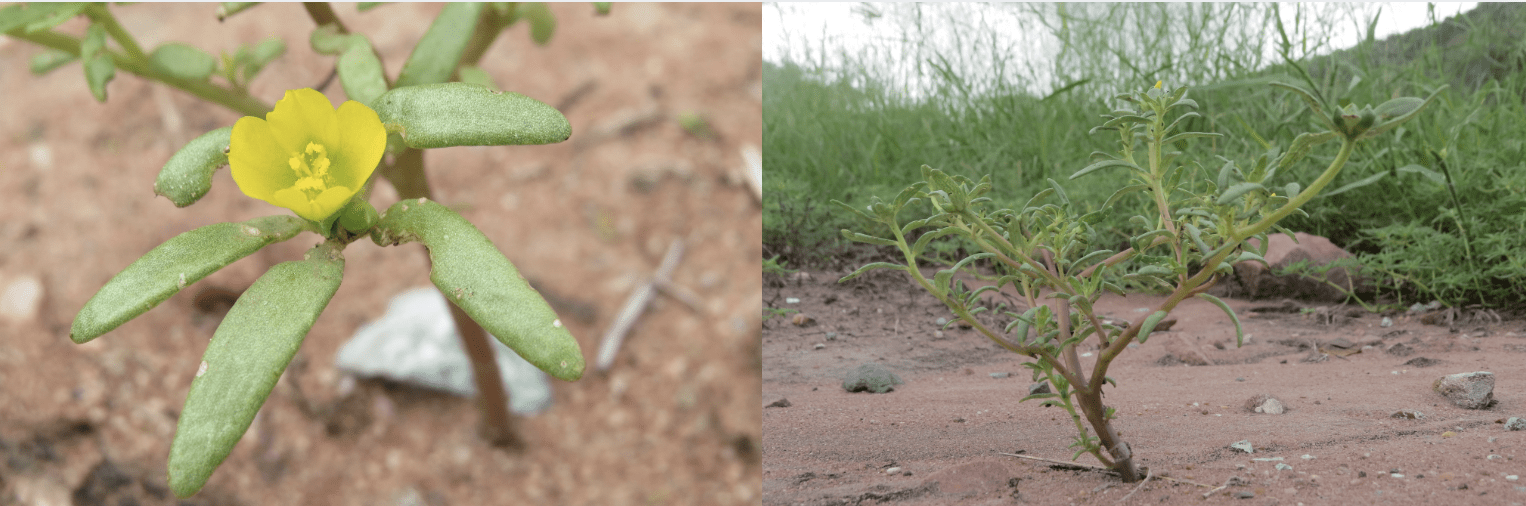
Portulaca trianthemoides, showing its erect to sub-erect growth form and the relatively large yellow flowers and narrowly oblanceolate leaves. Photos: Rangani Nemando.
About the authors
Wynston Woodenberg (w.woodenberg@sanbi.org.za; 031 262 4095) is a SANBI scientist doing plant taxonomy at the KwaZulu-Natal Herbarium, Durban.
Yanadayalan Govender (teddygovender18@gmail.com) is a retired former employee of the Parks Department, eThekwini Municipality.
Syd Ramdhani (Ramdhani@ukzn.ac.za) is a senior lecturer at the University of Kwazulu-Natal, Westville Campus.
JOIN BOTSOC
Know, grow, protect and enjoy South Africa’s indigenous plants.
JOIN NOW

Hours
Tuesdays from 08h00 to 16h00. Closed from Wednesday to Monday and public holidays.
Contact Us
We are experiencing intermittent faults with our landlines. If you can't get through on our landline +27 (0) 21 797 2090 , please phone or send a message to our alternate WhatsApp number: +27 (0) 65 922 6163.
Notice
From 1 March 2026, our office located inside Kirstenbosch National Botanical Garden (through Gate 2) will be open to assist members on Tuesdays only (08:00 – 16:00).
0 Comments