

Plant hitchhikers spell trouble for ecosystems and roads
Have you looked out the car window and noticed alien invasive plants growing along our roadsides?
These invaders spell trouble – not just for indigenous ecosystems, but also for the infrastructure of our roads, explains DR MOLESENG CLAUDE MOSHOBANE.
Lush greenery along South Africa’s roadsides, which could be hiding sneaky invasives
As we speed down highways and traverse country roads, the lush greenery along the roadside makes for a picturesque sight. But there’s more to this scene than meets the eye.
Hidden among the familiar native plants are silent trespassers – invasive species that are thriving along our roadsides. Invasive species are non-native plants, animals, or microorganisms that disrupt ecosystems. They often spread rapidly, outcompeting indigenous plants and become ecological troublemakers.
While their presence might not be immediately apparent to motorists and passers-by, these invaders are also wreaking havoc on our road infrastructure, leading to unforeseen environmental and economic consequences.
The invasion of roadsides
Our research is dedicated to understanding the intricate relationships between nature and human-made environments. We’ve delved into an intriguing facet of our world – the dynamic interplay between linear infrastructure, like roads, and the lush plant life that often flourishes along its edges.
We may not immediately associate tar roads with biodiversity, but research has shed light on a new perspective: linear infrastructure provides prime habitats for a rich variety of plant species, both native and invasive.
As travel gets easier and people travel more, roadsides have become hotspots for alien invaders to establish themselves.
Research conducted by experts such as Mola et al. (2011), Paiaro et al. (2011), and LaPaix et al. (2012) reveals that roadsides harbour high plant richness and serve as inviting territories for alien plants in particular. The proximity to the road itself plays a crucial role, with greater alien plant richness found closer to the road’s edge, gradually decreasing as we move farther away.
This correlation between roads and alien plants is no coincidence. Roads, studies have found, contribute to the increase of these invaders within adjacent natural communities. Moreover, vehicles can inadvertently become agents of dispersal for some of these alien plants. The seeds or propagules of invasive species can hitch rides on tires, undercarriages, or even within the vehicles themselves, facilitating their spread to new areas – and threatening the indigenous plants that call it home.
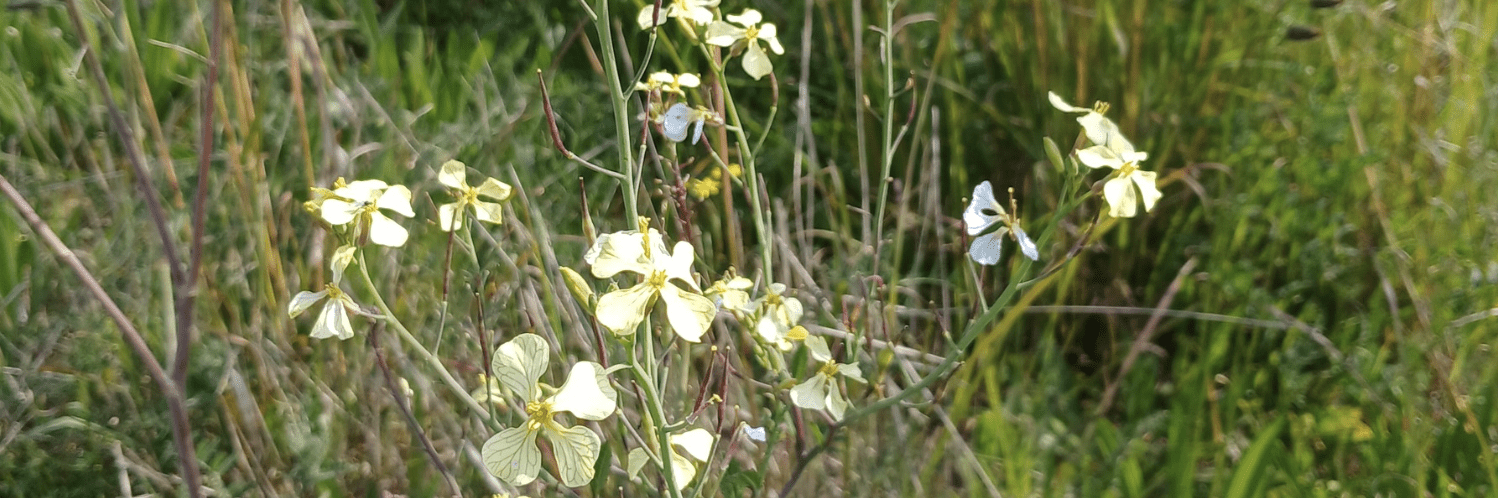
Charlock (Raphanus raphanistrum L.) which is considered a habitat-threatening invasive species, found along the roadside in the Western Cape
Trouble for our infrastructure
Now, what does all of this have to do with our travel habits and daily road use?
Much of the existing research on roadside plant invasion has focused on how often species occur, how many there are, how diverse they are, or general patterns. Some studies have gone further, projecting the potential impacts of individual invaders on the ecosystems they infiltrate.
Yet, a crucial piece of the puzzle has often been overlooked: the effects of plant invaders on the roads themselves and the associated infrastructure.
Imagine the toll that invasive plants can take on the very structures we rely on for transportation every day – especially given their abundance along roadsides. They can weaken road foundations, contribute to soil erosion, and, in certain cases, pose fire hazards. Additionally, tall and dense roadside vegetation can obscure visibility for drivers, potentially leading to vehicle accidents.
As we navigate the intricate network of linear infrastructure and the natural world that envelops it, we understand that the relationship between roads and invasive plant species is far more complex than meets the eye. We can see that the consequences go beyond the ecological sphere and can even impact road safety. Understanding how these species interact with our infrastructure is not just important for conservation – it will also help to ensure our roads remain functional and can be maintained as we continue to share our world with these “hidden” invaders.
Dr. Moleseng Claude Moshobane is a Senior Scientist at the Biodiversity Evidence Directorate of the South African National Biodiversity Institute (SANBI).
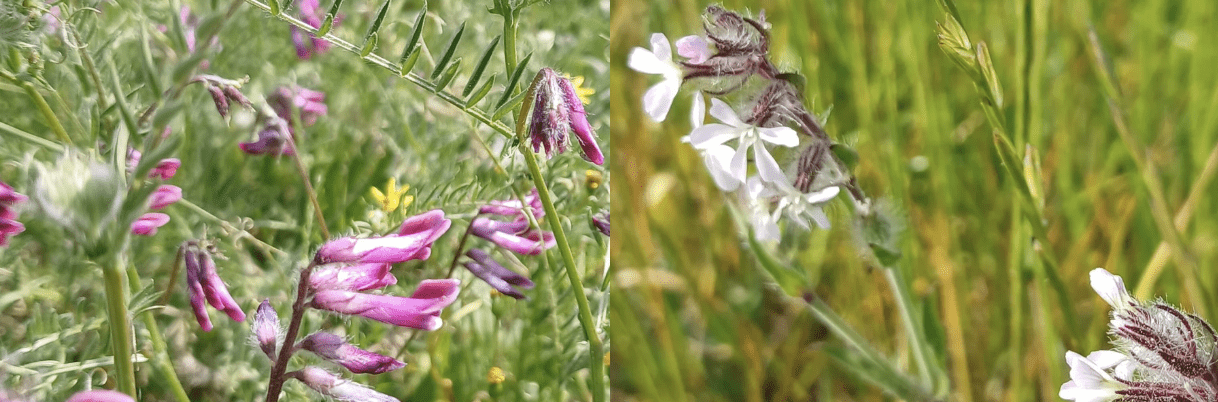
Hairy Vetch (Vicia villosa Roth subsp. villosa), an invasive with established populations in South Africa, found along the roadside in the Western Cape
Small-flowered catchfly (Silene gallica), a well-established roadside weed, found along the roadside in the Western Cape
References
- Cadenasso, M.L., Pickett, S.T.A., 2001. Effect of Edge Structure on the Flux of Species into Forest Interiors. Conserv. Biol. 15, 91–97. https://doi.org/10.1111/j.1523-1739.2001.99309.x
- Joly, M., Bertrand, P., Gbangou, R.Y., White, M.C., Dubé, J., Lavoie, C., 2011. Paving the way for invasive species: Road type and the spread of Common ragweed (Ambrosia artemisiifolia). Environ. Manage. 48, 514–522. https://doi.org/10.1007/s00267-011-9711-7
- Jubase, N., Renteria, J.L., Maphisa, D., Van Wyk, E., 2019. Asphodelus fistulous L., a newly discovered plant invader in South Africa: Assessing the risk of invasion and potential for eradication. Bothalia 49. https://doi.org/10.4102/abc.v49i1.2372
- LaPaix, R., Harper, K., Freedman, B., 2012. Patterns of exotic plants in relation to anthropogenic edges within urban forest remnants. Appl. Veg. Sci. 15, 525–535. https://doi.org/10.1111/j.1654-109X.2012.01195.x
- McDougall, K.L., Lembrechts, J., Rew, L.J., Haider, S., Cavieres, L.A., Kueffer, C., Milbau, A., Naylor, B.J., Nuñez, M.A., Pauchard, A., Seipel, T., Speziale, K.L., Wright, G.T., Alexander, J.M., 2018. Running off the road: roadside non-native plants invading mountain vegetation. Biol. Invasions 20, 3461–3473. https://doi.org/10.1007/s10530-018-1787-z
- Mola, I., Jiménez, M.D., López-Jiménez, N., Casado, M.A., Balaguer, L., 2011. Roadside Reclamation Outside the Revegetation Season: Management Options under Schedule Pressure. Restor. Ecol. 19, 83–92. https://doi.org/10.1111/j.1526-100X.2009.00547.x
- Moshobane, M., Olowoyo, J., Middleton, L., 2022. Alien plant species of Haenertsburg Village, Limpopo Province, South Africa. BioInvasions Rec. 11, 23–39. https://doi.org/10.3391/bir.2022.11.1.03
- Moshobane, M.C., Olowoyo, J.O., Kremer-Köhne, S., Middleton, L., 2022. First record of Leucanthemum vulgare (Lam. 1778) (Asterales: Asteraceae), ox-eye daisy in Limpopo province of South Africa. BioInvasions Rec. 11, 40–48. https://doi.org/10.3391/bir.2022.11.1.04
- Paiaro, V., Cabido, M., Pucheta, E., 2011. Altitudinal distribution of native and alien plant species in roadside communities from central Argentina. Austral Ecol. 36, 176–184. https://doi.org/10.1111/j.1442-9993.2010.02134.x
- Parendes, L.A., Jones, J.A., 2000. Role of Light Availability and Dispersal in Exotic Plant Invasion along Roads and Streams in the H. J. Andrews Experimental Forest, Oregon. Conserv. Biol. 14, 64–75. https://doi.org/10.1046/j.1523-1739.2000.99089.x
- Rahlao, S.J., Milton, S.J., Esler, K.J., Barnard, P., 2010. The distribution of invasive Pennisetum setaceum along roadsides in western South Africa: The role of corridor interchanges. Weed Res. 50, 537–543. https://doi.org/10.1111/j.1365-3180.2010.00801.x
- Rew, L.J., Brummer, T.J., Pollnac, F.W., Larson, C.D., Taylor, K.T., Taper, M.L., Fleming, J.D., Balbach, H.E., 2018. Hitching a ride: Seed accrual rates on different types of vehicles. J. Environ. Manage. 206, 547–555. https://doi.org/10.1016/j.jenvman.2017.10.060
JOIN BOTSOC
Know, grow, protect and enjoy South Africa’s indigenous plants.
JOIN NOW

Hours
Tuesdays from 08h00 to 16h00. Closed from Wednesday to Monday and public holidays.
Contact Us
We are experiencing intermittent faults with our landlines. If you can't get through on our landline +27 (0) 21 797 2090 , please phone or send a message to our alternate WhatsApp number: +27 (0) 65 922 6163.
Notice
From 1 March 2026, our office located inside Kirstenbosch National Botanical Garden (through Gate 2) will be open to assist members on Tuesdays only (08:00 – 16:00).
0 Comments