

Discoveries, campfires & togetherness: Conservation the Limpopo way
From finding critically endangered succulents clinging to quartz koppies, to inspiring a new generation of nature stewards, BOT SOC’s Limpopo Branch is turning discovery into action. Along the way, there’s plenty of laughter around the campfire, hikes up rugged mountains and a strong spirit of togetherness. KAMEGELO SOLOMON MODIMOLA explains.
PHOTOS BY KAMEGELO SOLOMON MODIMOLA & PRINCE MOLOKOMME
Spring in Limpopo has not only been a season alive with beautiful blooms. For the BOT SOC Limpopo Branch, the past months have been filled with exciting discoveries, tree planting, youth engagement and conservation adventures. From the white quartz koppies of the Mamabolo bushveld in the Capricorn district, through the bustling University of Limpopo campus, to the slopes of the Soutpansberg mountains in Mopani, our members and partners are proving what can be achieved when people and plants come together.

Our Limpopo Branch members went in search of the critically endangered Euphorbia groenewaldii around Polokwane, Limpopo in August 2025 – with great success.
Know: It was a season of discovery
For one critically endangered beauty, hope sprang from the power of citizen science. Euphorbia groenewaldii stands on the brink of extinction. But it was observed earlier this year during the City Nature Challenge – inspiring a team to go in search of it in quartz koppies around Polokwane in August 2025. I have now personally recorded more than 250 individual specimens, while a new population was also found in koppies of Mamabolo mountain bushveld. Despite these findings, major threats remain to the species, including trampling, development and harvesting.
Other conservation highlights in the area included sightings of Euphorbia cooperi var. cooperi (vulnerable), Elaeodendron transvaalense (near threatened) and Ledebouria crispa (endangered). These discoveries, logged on iNaturalist and shared with members of CREW, are lifelines for species whose futures depend on monitoring and advocacy. These trips also led to an interesting observation of what could potentially be a new Xerophyta species – which now needs to be identified.
Another exciting find this year was Adenia fruticosa ssp. fruticosa (Sekhukhune greenstem – a near threatened species). During a field survey, our team discovered a population thriving outside its known range. This was totally unexpected and highlights how much there is to learn about Limpopo’s flora.

Left: Euphorbia groenewaldii occurs on white quartz rocks (Photo: Kamogelo Solly Modimola). Right: Adenia fruticosa ssp. fruticosa (Photo: Prince Molokomme).
Exploring other places in the Sekhukhune District in Limpopo also revealed more hidden gems. On a three-day camping trip with the Limpopo Economic Development, Environment & Tourism Department (LEDET) and youth from Polokwane and Haenertsburg, the hike up rugged mountains was rewarded. Here the group rediscovered Drimiopsis gasekhukhunei, a rare hyacinth long thought lost to the area – reminding us of the urgent need to protect this region.
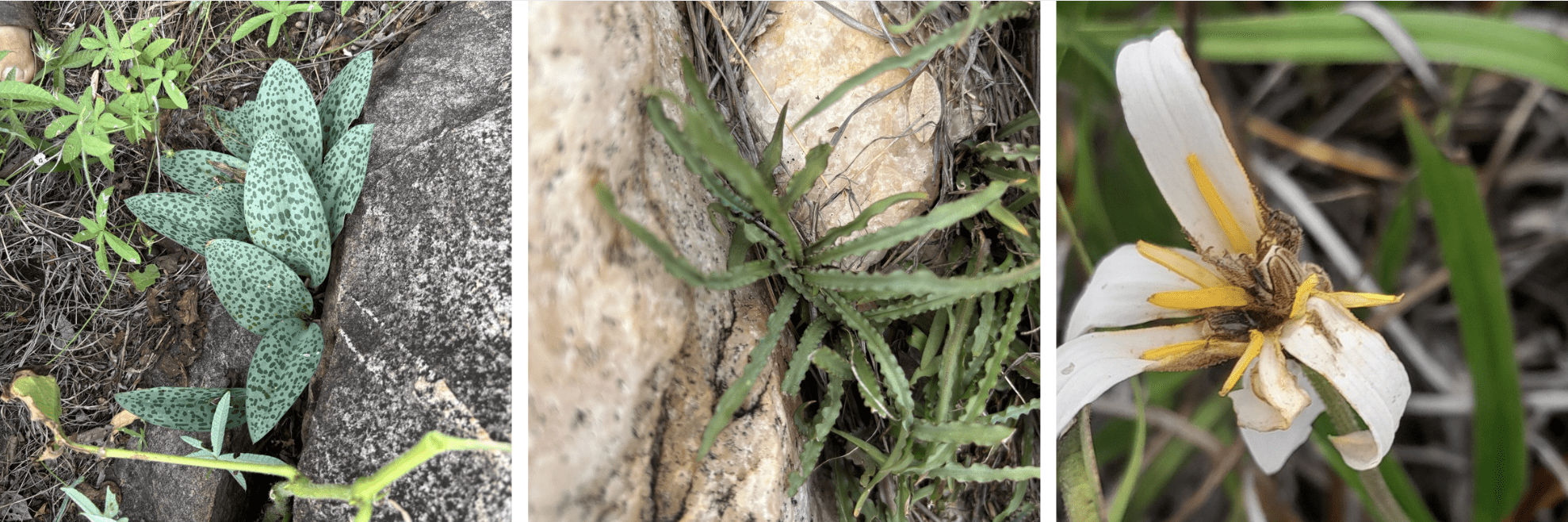
Left: Drimiopsis gasekhukhunei. Centre: Ledebouria crispa photographed on white quartz rocks (Photo: Troos van der Merwe from iNaturalist). Right: An unknown Xerophyta species (Photo: Kamogelo Solly Modimola).
Grow: Nurturing people and plants
The Limpopo Branch also embraced the “growing” side of the BOT SOC mantra. At the University of Limpopo Arbour Day celebration on 5 September 2025, branch members joined hands with students from varying faculties. Through talks on citizen science, GIS in biodiversity and the power of community outreach, knowledge was shared – which we trust will grow these students into nature stewards.
The highlight was the tree planting ceremony: Westfalia Merensky Nursery donated two quinine trees (Rauvolfia afra), a sausage tree (Kigelia africana) and two African olive trees (Olea europaea ssp. africana) which were planted on the university campus.
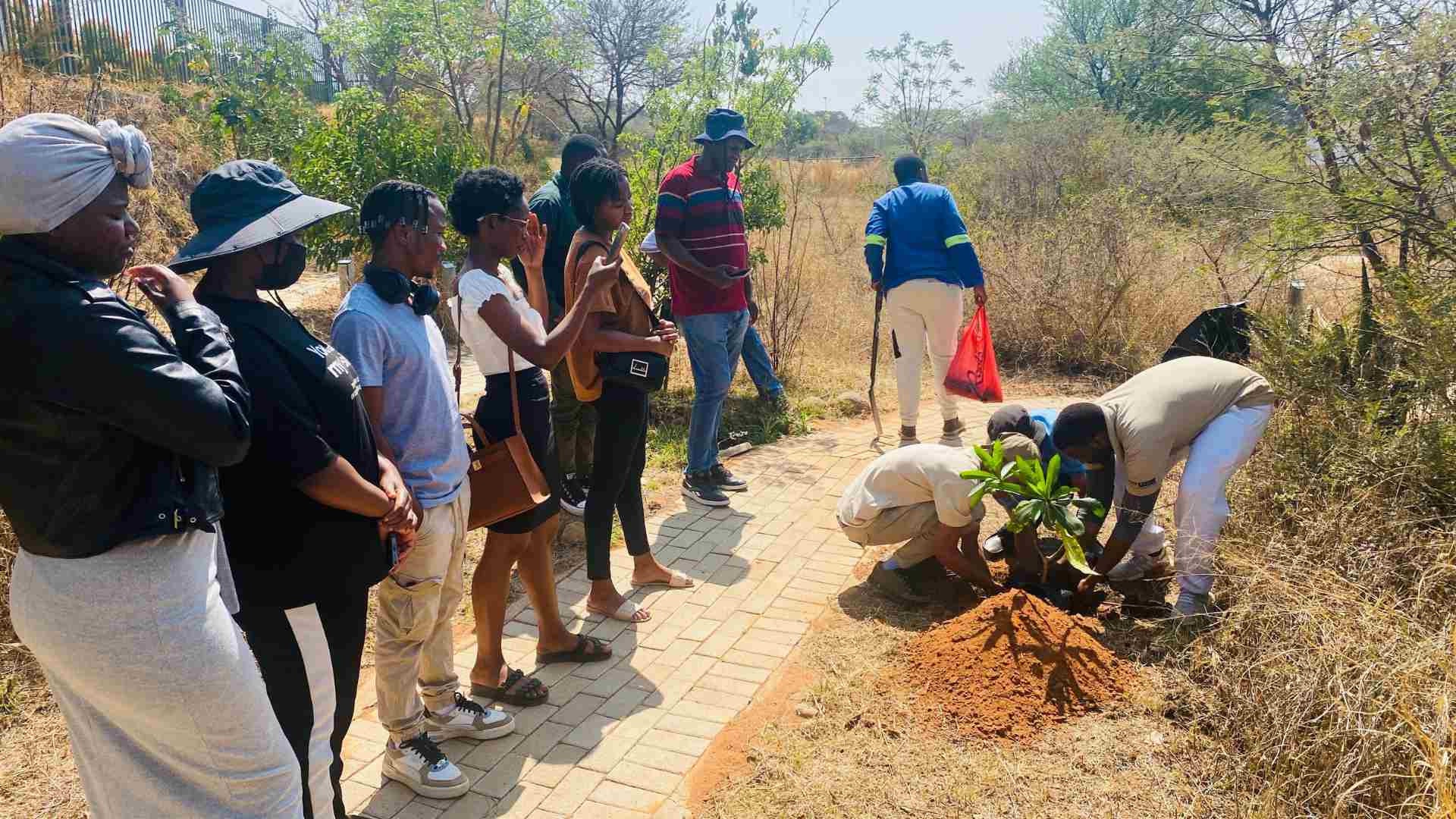
Our Arbour Day celebrations brought students together to plant at the University of Limpopo botanical garden.
“At home (in Limpopo), every koppie, every grassland and every plant… is a reminder that conservation begins with curiosity – and grows stronger when we act together.” – Modimola K.S.
Camps like those held at Zvakanaka farm help grow our nature custodians even further. In August, branch members gathered for a one-night training camp on the farm, immersing themselves in plant identification and using iNaturalist. Peer-to-peer learning and shared fieldwork strengthened skills while reinforcing the urgency of tackling invasive alien plants like bugweed, black wattle and lantana. This served as an opportunity for members to not only sharpen their botanical skills, or to joyously get lost on mountain trails, but to strengthen our shared ethic of conservation.

Left: BOT SOC Limpopo Branch members had inspiring get-togethers in the past few months, including a camping trip at Zvakanaka Sam’s campsite. This included hiking trips into the mountain (right).
Protect: How citizen science contributes to conservation
Citizen science has become one of our most powerful tools – and nowhere was this clearer than during our Arbour Day iNaturalist demonstration. Here students learned to document biodiversity with a few taps on their phones. Each observation made contributes to a global database, ensuring Limpopo’s plants are seen, identified and protected, even beyond our province.
At Zvakanaka farm, members turned data collection into direct action, uploading observations from an under-documented area and improving Limpopo’s representation in global records. And at Schuinsdraai, hikers catalogued plants in real time, showing that even a rugged trail can be a classroom. These efforts feed into larger projects like the Great Southern Bioblitz 2025, proving that to protect plants, grassroots participation is key.

Our Limpopo Branch members spent considerable time logging species on iNaturalist, showing the power of citizen science.
Enjoy: From campfire conversations to mountain treks
Conservation can be hard work, and sometimes disheartening when we see the loss, but at its heart it can bring great joy. Like when students watered their newly planted trees, or rediscovered a rare succulent, or our sense of accomplishment after a campfire discussion. Around the fire and during hikes, members reflected on their experiences. One student exclaimed, “I never realised that a single observation could help scientists around the world!” Another said, “Seeing these plants in their natural habitat makes me want to protect them forever.” These voices capture the energy and inspiration that emerge when people connect with the veld, and show how discovery turns into conservation action.
The Limpopo Branch thrives on this spirit of togetherness. With dreams of forming sub-committees across the province in Mopani, Sekhukhune, Vhembe and the Waterberg district, our reach is growing, and so is the impact of our work. Conservation here is our responsibility. But it also brings us collective joy to protect Limpopo’s unique flora. The campfire conversations, the joy we felt in working together, the new faces that joined this drive reminded us that the future of the veld rests in the hands of those who care enough to act.
Join the movement
The BOT SOC Limpopo Branch thrives because of people: our students, teachers, researchers, families and communities who care about plants and the places they grow. We invite schools, universities, members and organisations to partner with us: whether through workshops, campus-greening projects, veld excursions, or citizen science training. Together, we can grow knowledge, nurture young conservationists and protect our special Limpopo veld.
And there’s no better time to get involved. This spring, Limpopo will be part of the Great Southern Bioblitz 2025, a global citizen-science event where we’ll photograph, observe and identify our special species, to capture the story of our biodiversity. By joining in, you’ll not only be celebrating Limpopo’s natural heritage, but also helping to put our province on the world’s biodiversity map.
Who can join?
· Schools & universities (workshops, campus greening, field trips)
· Conservation groups & NGOs (partnership projects)
· Individuals & families (membership, volunteering, citizen science)
A bioblitz not to be missed
Join us for the Great Southern Bioblitz 2025 this spring. Scan the QR code to join our project, and help put Limpopo’s biodiversity on the global map by uploading your observations to iNaturalist.
Contact the Limpopo Branch for more: Email: limpopo@botanicalsociety.org.za, or check out our activities on Facebook (@BotSocLimpopo), Instagram (@botsoc_limpopobranch) or iNaturalist (Great Southern Bioblitz Limpopo).
Kamogelo Solomon Modimola is information officer for the BOT SOC Limpopo branch. He is passionate about citizen science, youth engagement and growing a culture of conservation in Limpopo.


JOIN BOTSOC
Know, grow, protect and enjoy South Africa’s indigenous plants.
JOIN NOW

Hours
Tuesdays from 08h00 to 16h00. Closed from Wednesday to Monday and public holidays.
Contact Us
We are experiencing intermittent faults with our landlines. If you can't get through on our landline +27 (0) 21 797 2090 , please phone or send a message to our alternate WhatsApp number: +27 (0) 65 922 6163.
Notice
From 1 March 2026, our office located inside Kirstenbosch National Botanical Garden (through Gate 2) will be open to assist members on Tuesdays only (08:00 – 16:00).
0 Comments